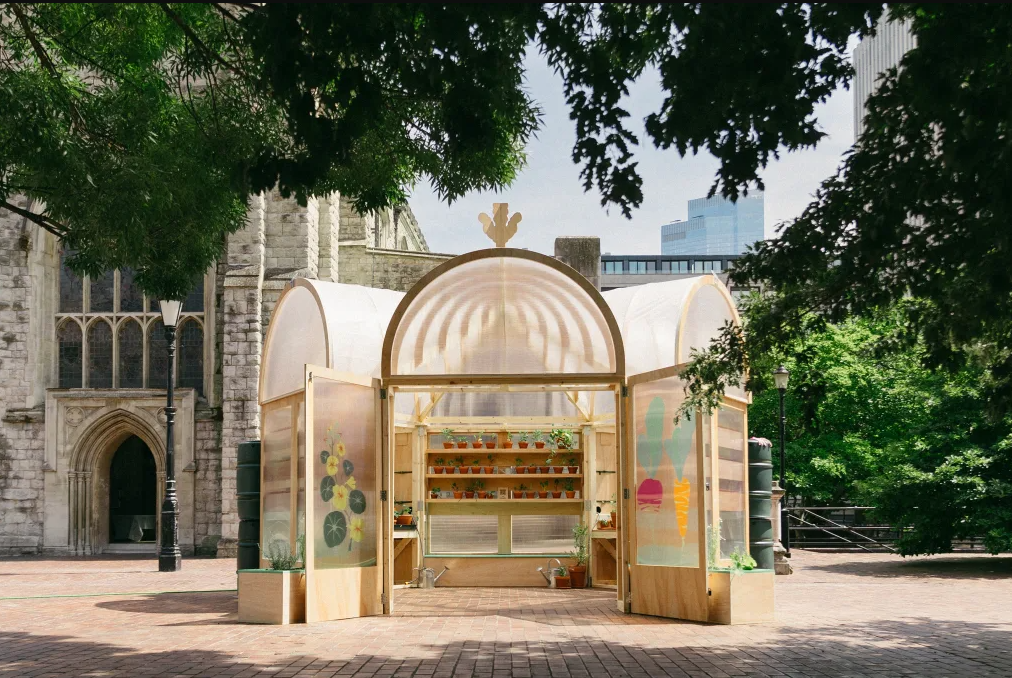
🌺 The House that Learnt to Bloom, a Workshop by Charlotte Moore
📅 Wednesday 15th July 2026 + Saturday 1st August 2026
⌚ 11:00 – 12:30 | 12:45 – 14:15 | 14:30 – 16:00 | 🔗 Click here to book!
🔍 This workshop explores the reciprocal relationship between plants and architecture, how vegetation colonises and transforms built structures over time and how architecture itself creates new ecological niches that enable unexpected forms of plant life to emerge.
💧 Beginning with historical examples – such as Richard Deakin’s studies of the Flora of the Colosseum of Rome, Joseph Gandy’s Rotunda of the Bank of England, Victorian hothouse culture and botanical gothic fiction such as John Collier’s Green Thoughts – we will consider architecture not as a static backdrop for nature but as an active participant in ecological processes.
🐦 Greenhouses, in particular, demonstrate how architecture produces artificial climates that allow species to grow beyond their native environments, fostering new botanical assemblages and forms of hybridisation. This raises a contemporary question: how might architectural elements such as façades, ornament, ledges, cornices and niches move beyond surface decoration to become living environmental infrastructure? Rather than merely supporting plants, could they become spaces that actively cultivate biodiversity, provide habitat, and generate new relationships between species?
🤔 To translate these questions into a shared material experiment, the workshop shifts from discussion to speculative making. Over 1 1/2 hours, participants will be introduced to techniques for sculpting botanical forms, learning how to observe, abstract and combine plant morphologies through three-dimensional making.
⚪ Working collectively, the group will construct a large hybrid plant structure inspired by observations of the Barbican’s planting, the unique climatic conditions of the Veggery, and historical botanical imagery such as Erbario Herbal and Goethe’s concept of the Urpflanze. Rather than representing any single species, this collective sculpture imagines a plant adapted specifically to the Veggery’s architectural environment. A speculative organism whose morphology responds to ledges, cavities, façades and enclosed climates. Through botanical sculpture, participants will explore how architecture might become an active medium for cultivating new ecological futures, transforming ornament from surface decoration into living environmental
infrastructure.